Industries

The same platform, configured for five very different floors.

A foundry, a distribution centre and a shopping centre all have cameras and all have problems. What differs is the environment the cameras work in, the rules that matter, and who is allowed to see the footage. This page covers that difference.
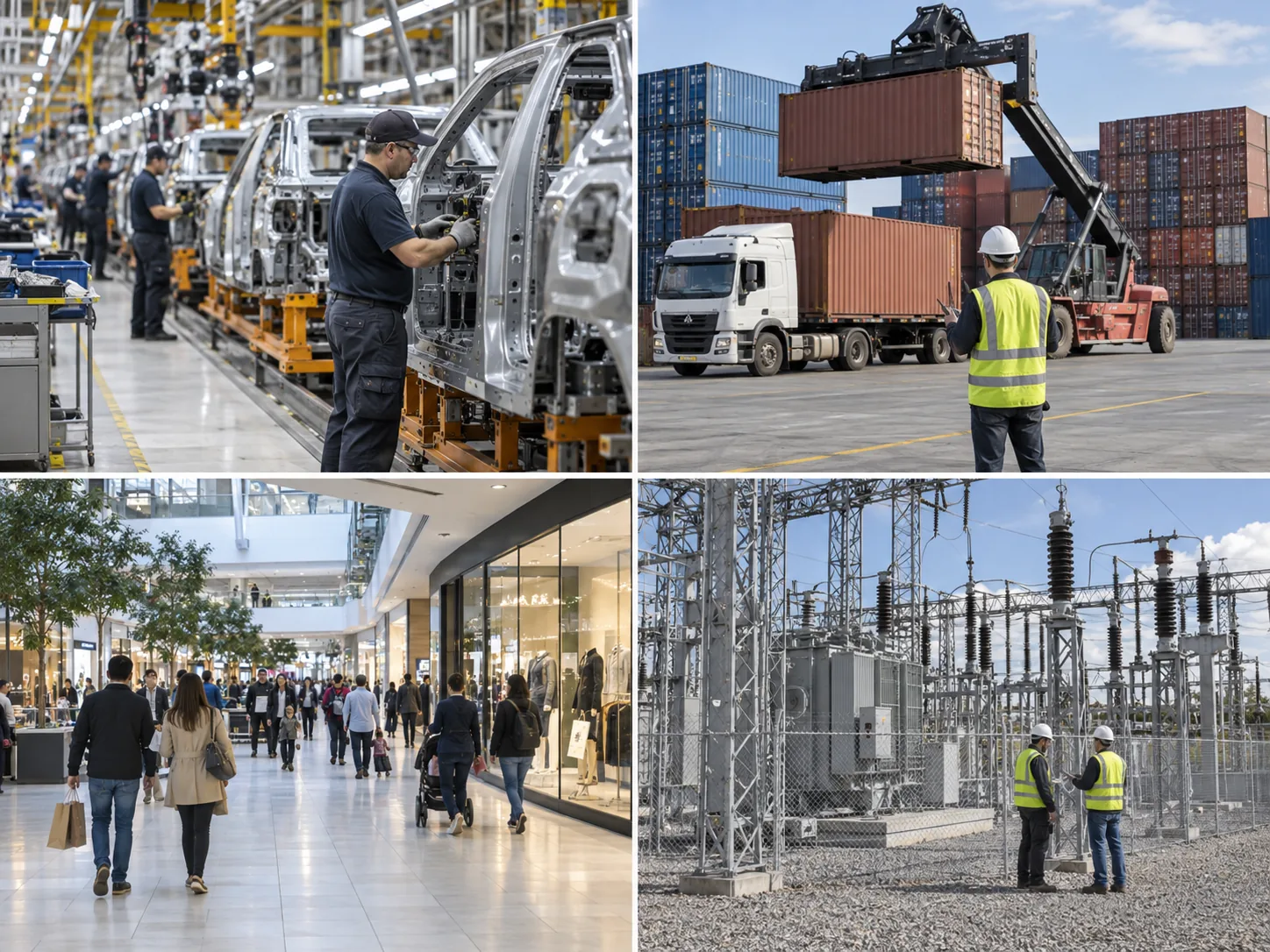
Four monitored environments: a manufacturing line, logistics yard, retail concourse and electrical substation.

What does not change

Four things every sector asks for first.

Whatever the environment, the first conversation lands on the same four constraints. They are answered the same way in every deployment.

Keep the cameras

Estates are replaced on a ten-year cycle. No sector wants a vision project to trigger a capex round.

Keep video in place

Sites with staff, customers or the public in frame want video processed where it already lives.

Keep the rules editable

Operational knowledge sits with supervisors, not with a central data team, in every sector.

Keep the record

Every sector needs an attributable history of what was observed and who responded.

01 · Manufacturing

Manufacturing

Fixed cells, defined cycles, and a strong existing culture of measuring everything that a machine does. The gap is usually the manual work between the machines.

  • Idle stations
  • Walkway breaches
  • Spills and housekeeping
  • PPE presence

A plant already knows when a machine faults, because the machine tells it. What the plant does not know is why the line stopped when nothing faulted: the operator waiting on a part, the buffer that filled, the material handler who could not get down an aisle because a cage was parked in it. Machine data is silent on all three.

Agents in a plant are usually scoped to a station or a buffer rather than to a whole hall, because the rules depend on the normal cycle at that point. A station that is unoccupied for ninety seconds is normal in one cell and a stoppage in another, so the threshold comes from the cell's own standard work rather than from a plant-wide default.

Safety scenarios sit alongside flow scenarios, and they are usually owned by different people. Pedestrian routes through a plant are crossed by forklifts at predictable points, and those crossings are where a segregation agent earns its place. Spills and obstructions are the other common start, because both are cleared faster when somebody is told immediately rather than at the next walk-round.

The environment is the hard part. Lighting varies from bright bay doors to unlit aisles, lenses collect dust, and a camera that was installed for a security purpose may be looking down a rack rather than across a floor. Onboarding checks the view against the rule before anything is configured, and repositioning a camera is a cheaper fix than a narrower rule.

Typical first agent

Idle station or blocked aisle on the constraint resource. It is the scenario where the operational owner already has a number they are accountable for.

02 · Logistics

Logistics and distribution

Large outdoor and semi-outdoor areas, high vehicle density, and a workforce that changes every week. Coverage is usually good and attention is the scarce resource.

  • Dock flow
  • Yard congestion
  • Trailer movements
  • Vehicle segregation

A distribution centre is a yard with a building attached, and most of its losses happen outside. Trailers wait where they should not, lanes fill without anyone noticing, and a door sits empty during a booked slot while a queue builds at the next one. None of that is visible in the warehouse management system, which knows what was scanned rather than what was waiting.

The dock agent described in the use cases is the common entry point, and it usually starts on the lane that the site already complains about. Because a yard is covered by a small number of cameras with wide views, a single agent can often span four doors, which makes the first deployment unusually cheap in camera terms.

Weather is the environmental constraint. Rain on a lens, low sun across an apron, and headlights at night all degrade a scene, and a rule that names a vehicle class copes with those changes better than a motion rule does. Sites with heavy night operation usually run the agent's schedule against the shift pattern rather than against the clock.

Agency labour changes who is on the floor each week, which makes escalation design matter more than threshold tuning. Agents route to roles rather than to individuals, so a new shift supervisor inherits the same path without a configuration change.

Typical first agent

Dock and yard flow on the busiest set of doors, with the yard marshal as the named recipient.

03 · Retail

Retail and hospitality

Public spaces with a duty of care to customers who have not consented to being analysed. This is where privacy design stops being a policy question and becomes an architecture one.

  • Queue length
  • Aisle obstruction
  • Spills
  • Closing routines

A store's operational problems are smaller and more frequent than a distribution centre's. A queue that reaches six people, a spill nobody has coned, a cage left in an aisle during trading hours. Individually trivial, collectively the difference between a good and a bad trading day, and currently managed by whoever happens to walk past.

Privacy zones are set up before any agent is switched on, and they cover anything that is not part of the operational question: tills and payment areas, staff welfare routes, neighbouring property, and any area where the only thing the camera adds is identification. Excluded areas are removed from the frame before detection runs, so the model never receives those pixels.

Agents in retail work with counts and durations rather than with individuals. A queue agent measures how many people are waiting and for how long; it does not track a person around a store. That distinction is what keeps a useful operational tool separate from a surveillance product, and it is enforced by what the rules are allowed to express.

Multi-site retailers usually want one agent definition applied everywhere with per-store thresholds, because a queue threshold that suits a city store is wrong for a retail park. The agent library carries the definition; the local threshold carries the store's reality.

Typical first agent

Checkout queue length during trading hours, with a privacy review completed first.

04 · Critical infrastructure

Critical infrastructure and utilities

Remote, distributed, and often unmanned. Sites where an intrusion is not a theft problem but a continuity problem, and where nobody is on hand to look at a screen.

  • Perimeter breach
  • Unmanned site activity
  • Access route obstruction
  • Plant room entry

A substation, a pumping station or a water treatment works is monitored from somewhere else entirely. The events that matter are rare and the consequences are disproportionate, which makes false positives unusually expensive: an unnecessary site visit at 03:00 costs a response that could have gone to a real incident.

Rules here are narrow by necessity. A perimeter agent names the classes it cares about, a direction of travel across the fence line rather than mere presence near it, and a schedule that reflects when contractors are expected. Wildlife, vegetation movement and lighting changes are excluded by condition, not by reducing sensitivity until the real events disappear with the noise.

Connectivity is often the deciding factor in deployment topology. Many of these sites have constrained or intermittent WAN links, which pushes the runtime to an edge appliance so that analysis continues and events queue locally when the link is down.

Compliance posture is agreed per operator rather than assumed. Operators in regulated sectors have their own security requirements and their own audit expectations, and the deployment model, access control and retention configuration are set to match those rather than to a generic template.

Typical first agent

Out-of-hours perimeter movement at a single unmanned site, with escalation to a regional control room.

05 · Public space

Public space, transport and venues

High footfall, mixed traffic, and a duty to keep routes open. Crowd flow matters more than individual behaviour, and the questions asked are almost always aggregate.

  • Flow and congestion
  • Blocked routes
  • Restricted area entry
  • Incident detection

In a station, an airport concourse or a venue, the operational question is usually about movement: is this route passable, is this area filling, has something stopped in a place where stopping causes a knock-on effect. Those are aggregate questions, and they are answered with counts and durations rather than with identities.

Visibility and signage are obligations in these environments, and so is restraint. A venue deploying vision has to be able to explain what it analyses and what it does not, to regulators, to staff and often to the public. Privacy zones that exclude an area before inference are the clearest form that explanation takes, because they are a property of the pipeline rather than a promise about behaviour.

Events in public space need to reach people who are already moving. Escalation paths route to a control room, a duty manager or a response team, with the clip attached so that the first minute of a response is spent acting rather than assembling context.

Typical first agent

Route obstruction or restricted-area entry, scoped tightly and reviewed with the operator's own information governance team.

Across sectors

What actually differs between sectors.

The platform is the same everywhere. These four variables are what a deployment configures differently, and they are the questions worth answering before a pilot starts.

How deployment variables change by sector. The rule engine is identical in each case.
Variable Manufacturing Logistics Retail and public space Critical infrastructure
Scene conditions Indoor, mixed lighting, dust on lenses. Outdoor aprons, weather, low sun, headlights. Indoor, stable lighting, dense footfall. Remote, unlit, weather-exposed, low traffic.
What the rules target Cycle deviation at a station. Dwell time and queue formation. Counts, durations and obstruction. Direction of travel across a boundary.
Cost of a false positive A supervisor walks to a cell. A marshal checks a lane. A colleague leaves the floor briefly. A site visit, possibly overnight.
Privacy pressure Staff only; workforce consultation expected. Staff and drivers; mixed employment status. Members of the public in frame by default. Low footfall, but regulated operators.
Usual deployment choice Edge appliance on the plant network. Edge or private cloud, by site connectivity. Private cloud or managed, many small sites. Edge, because the WAN cannot be relied on.

Tell us which floor you are standing on.

We will show you the agents that fit your environment, the rules they would use, and the deployment model your network team is likely to accept.